One Year Later: How Nonprofits Continue to Navigate the Aftermath of the 2025 Rescissions Act
Key Takeaways
The 2025 Rescissions Act continues to reshape the nonprofit sector one year later. The cancellation of approximately $9 billion in previously appropriated federal funding has had lasting effects on organizations serving communities in the U.S. and around the world.
Funding instability has affected multiple sectors simultaneously. International aid organizations, public media, global health providers, and community nonprofits continue adapting to reduced federal support while demand for services remains high.
The impacts extend far beyond individual organizations. Funding reductions have contributed to disruptions in healthcare, education, humanitarian response, refugee assistance, local journalism, and emergency communications.
Nonprofits have demonstrated remarkable resilience. Organizations have diversified fundraising, formed new partnerships, streamlined operations, and developed innovative ways to continue serving communities despite ongoing financial challenges.
Philanthropy plays an increasingly vital role. As government funding becomes less predictable, individual donors, foundations, and corporate philanthropy are helping nonprofits bridge funding gaps and sustain essential services.
The need for nonprofit visibility has never been greater. Helping donors understand how funding changes affect organizations enables communities to respond more quickly and effectively when critical services are at risk.
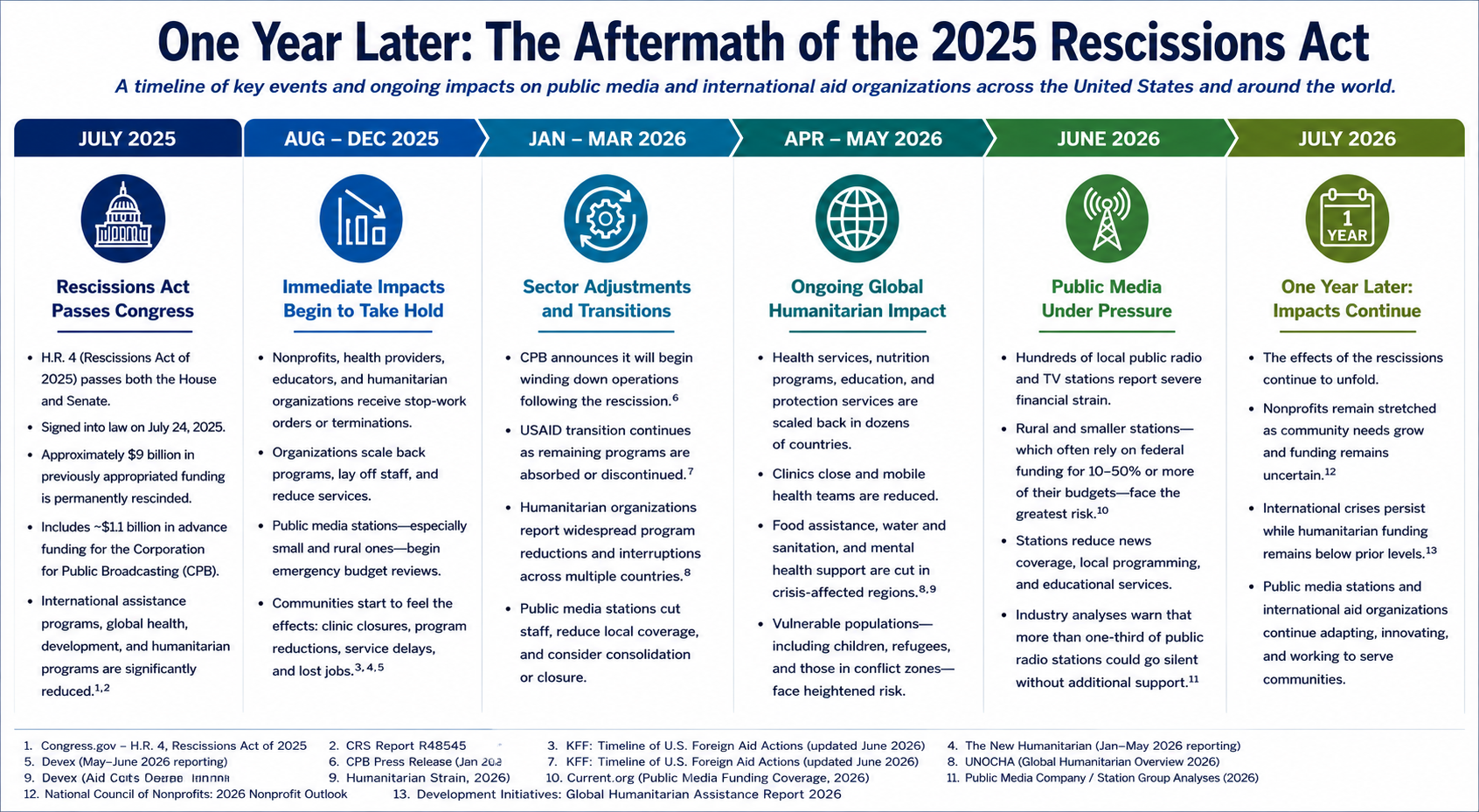
On July 24, 2025, Congress passed the Rescissions Act of 2025 (H.R. 4), permanently canceling approximately $9 billion in previously appropriated federal funding. Among other provisions, the law rescinded funding for international assistance programs, global health initiatives, development assistance, and approximately $1.1 billion in advance funding for the Corporation for Public Broadcasting (CPB), marking one of the most significant shifts in federal support for nonprofit partners in recent years.
For many Americans, the passage of H.R. 4 was simply another headline from Washington. For nonprofit organizations, however, it represented the beginning of a new chapter defined by uncertainty, difficult decisions, and an urgent need to identify new sources of support.
A year later, the effects are still unfolding.
At Charity Bridge Fund, we've seen firsthand how organizations across sectors continue adapting to a changing funding landscape. While the Rescissions Act directly affected specific federal funding streams, it also became part of a broader shift that has required nonprofits to rethink how they sustain critical services. From humanitarian organizations to public media, nonprofits are finding innovative ways to continue serving their communities despite significant funding challenges.
What the Rescissions Act Changed
The Rescissions Act permanently canceled funding that had already been appropriated by Congress but had not yet been obligated. The recissions included funding for Development Assistance, Global Health Programs, International Disaster Assistance, Migration and Refugee Assistance, USAID operating expenses, and advance appropriations for the Corporation for Public Broadcasting, among other programs.
For many nonprofit organizations, federal funding is the foundation that supports long-term planning, staffing, partnerships, and the delivery of essential services. When those resources change unexpectedly, organizations must quickly adapt while continuing to meet growing community needs.
The Human Impact
One year later, the effects of those funding changes are visible across communities in the U.S. and around the world.
Supporting Communities in Crisis
International humanitarian organizations have faced equally significant challenges. Since mid-2025, the restructuring of U.S. foreign assistance and the dissolution of USAID have reshaped the way humanitarian programs are funded around the world. Organizations have reported clinic closures, workforce reductions, delayed emergency responses, and the cancellation of long-standing development programs. Humanitarian organizations report that needs continue to outpace available funding.
Relief International, one of the organizations featured on Charity Bridge Fund, provides health care, nutrition, education, clean water, sanitation, hygiene, and livelihood programs across 14 countries throughout Africa, Asia, and the Middle East. Its community-based approach allows local teams to respond quickly in some of the world's most fragile environments.
But the organization lost $21 million in U.S. government funding during 2025, forcing difficult decisions across multiple countries. Education services, health facilities, protection centers for women and girls, psychological supports, and more were impacted.
Funding instability affects far more than individual projects. Reliable funding allows organizations to recruit and retain staff, strengthen health systems, and build long-term resilience within communities. When funding becomes unpredictable, those long-term investments become significantly more difficult to sustain.
Organizations working in global health, refugee assistance, food security, and emergency response continue to report that funding uncertainty has forced them to reduce services even as humanitarian needs remain historically high. Recent analyses estimate that disruptions to U.S.-supported global health and development programs are continuing to contribute to widespread service interruptions across dozens of countries.
Protecting Children's Health and Education
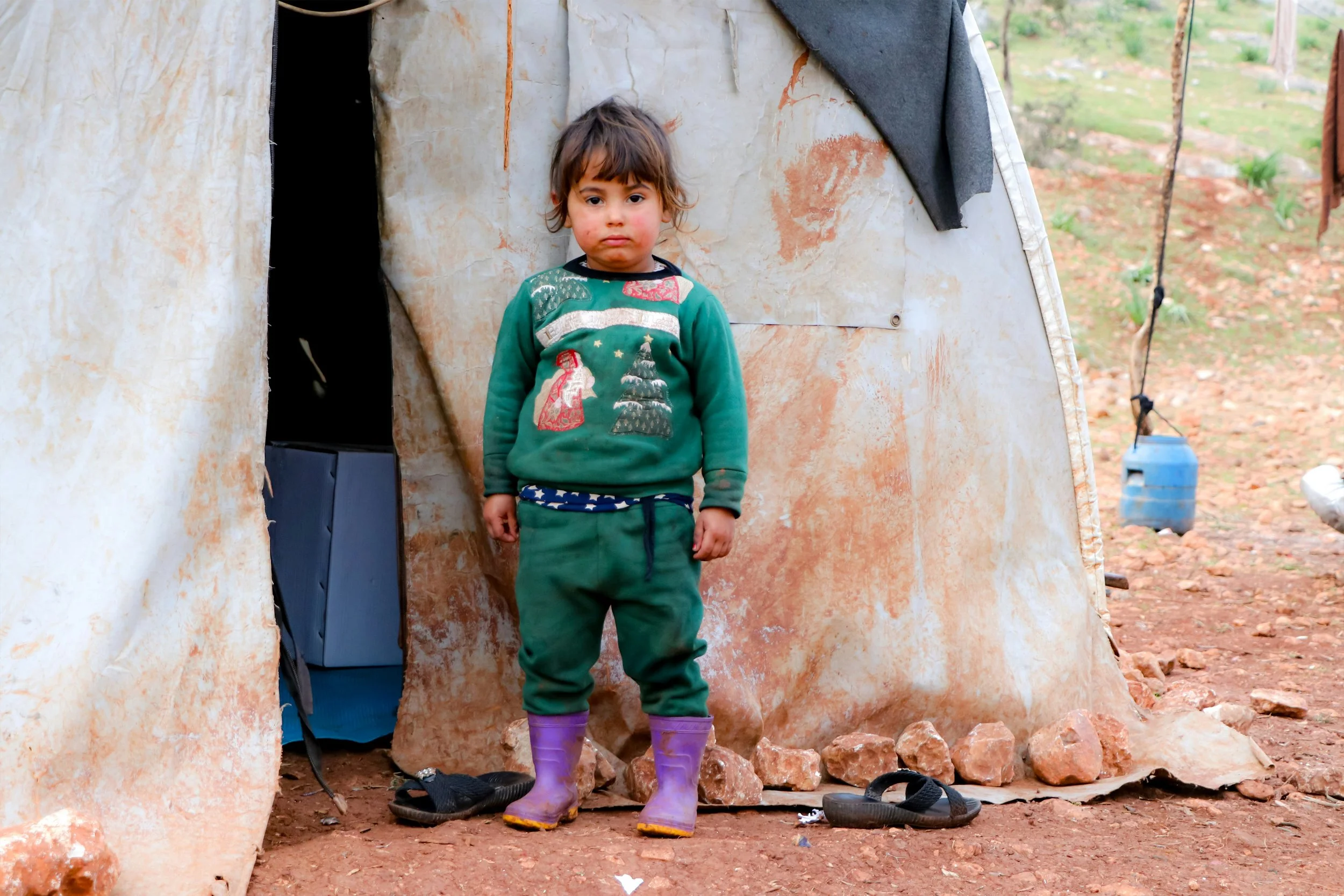
Save the Children, another Charity Bridge Fund partner, has highlighted the risks facing vulnerable children globally following the termination of a U.S.-funded health and nutrition awards, as well as funding supporting refugee programs.
Without replacement funding, health facilities and mobile medical teams serving face closure, placing essential services at risk. These include childhood vaccinations, maternal health care, nutrition programs, reproductive health services, and access to lifesaving medicines. And the long-term implications extend well beyond immediate healthcare. Funding reductions to health facilities could significantly reduce access to long-term treatment for childhood illnesses, malnutrition screening, frontline health worker training, and community nutrition education in areas where healthcare infrastructure is already limited.
When it comes to reduced support for refugee children, Save the Children warns that children face increased risks of interrupted education, worsening health outcomes, malnutrition, exploitation, child labor, and long-term psychological trauma. The organization now has a limited ability to strengthen local civil society organizations that provide sustainable, community-based support for refugee families.
Save the Children's work illustrates another important reality: humanitarian organizations are increasingly focused not only on responding to immediate crises but also on strengthening local partners that can continue serving communities over the long term. Global need continues to rise even as available humanitarian funding has declined, making collaboration among governments, philanthropy, nonprofits, and local organizations more important than ever.

Preserving Local Journalism and Public Media
The Recissions Act of 2025 also rescinded approximately $1.1 billion in advance funding for the Corporation for Public Broadcasting (CPB), which historically distributed the majority of its federal appropriation directly to locally owned public television and radio stations across the country. This prompted CPB to begin winding down its operations immediately and forced hundreds of local public radio and television stations to reassess their budgets. While many large metropolitan stations have continued operating, industry leaders have warned that small and rural stations remain particularly vulnerable.
In response, many stations have warned that the loss of federal support threatens local journalism, educational programming, emergency communications, and cultural programming.
One organization responding proactively is New York Public Radio, another nonprofit featured on Charity Bridge Fund. They launched a Station-to-Station Programming Project, designed to make nationally recognized programming available free of charge to public radio stations across the country.
New York Public Radio produces programming carried by more than 700 stations nationwide, so through this initiative, stations facing financial pressure can continue offering high-quality news, cultural, and educational programming while investing their limited resources in serving local audiences.
The long-term implications extend beyond broadcasting. Without local public media, communities lose trusted reporting on local government, school boards, public safety, and elections. Emergency alert systems become weaker. Programming created by Native, Black, Latino, immigrant, and Appalachian communities becomes more difficult to produce and distribute nationally. As local journalism declines, so too does access to trusted, community-centered information.
Philanthropy Has Never Been More Important
Over the past year, nonprofits have demonstrated remarkable resilience. Organizations have streamlined operations, launched emergency fundraising campaigns, formed new partnerships, and continued serving their communities despite unprecedented challenges.
But resilience alone cannot replace lost funding.
Only collective action can.
The challenges facing the sector remain significant, but so does the opportunity for philanthropy to make a meaningful difference.
Every donation helps organizations continue providing healthcare, educating children, supporting families, informing communities, responding to disasters, and building stronger futures.
Bridging the Gap
The organizations featured on Charity Bridge Fund represent a wide range of causes—from humanitarian aid and children's health to public media, environmental conservation, education, housing, food security, and community development.
Take action now to preserve vital services.
Frequently Asked Questions
What was the Rescissions Act of 2025?
The Rescissions Act of 2025 (H.R. 4) permanently canceled approximately $9 billion in previously appropriated federal funding across several programs, including international assistance, global health, development initiatives, and advance funding for the Corporation for Public Broadcasting (CPB). The law represented one of the most significant changes to federal nonprofit funding in recent years.
Why did the Rescissions Act have such a significant impact on nonprofits?
Many nonprofit organizations rely on multi-year federal funding to plan programs, hire staff, build partnerships, and deliver services. When previously approved funding is withdrawn, organizations often must quickly adjust operations while continuing to meet growing community needs.
Which nonprofit sectors were most affected?
The funding changes affected organizations working in international humanitarian assistance, global health, refugee services, public media, education, food security, community development, and other sectors that rely on federal partnerships to deliver essential services.
How has international humanitarian work been affected?
Many humanitarian organizations have reported reductions in healthcare services, nutrition programs, education initiatives, refugee assistance, and emergency response efforts as they adapt to changing funding levels. At the same time, global humanitarian needs continue to remain high in many regions.
Why does public media funding matter?
Public media organizations provide trusted local journalism, educational programming, cultural content, and emergency communications. Funding reductions can make it more difficult for local stations (particularly those serving rural communities) to maintain these essential public services.
How have nonprofits responded over the past year?
Organizations have pursued new fundraising strategies, strengthened relationships with private donors and foundations, formed collaborative partnerships, streamlined operations, and explored innovative approaches to maintaining services despite financial uncertainty.
Why can't philanthropy fully replace government funding?
Private philanthropy provides important flexibility and can respond quickly to urgent needs, but federal funding often supports programs at a scale that individual donors and foundations alone cannot fully replace. Strong communities typically benefit from a combination of public investment, private philanthropy, and nonprofit leadership.
Why is funding stability important for nonprofit organizations?
Stable funding allows nonprofits to retain experienced staff, invest in long-term community partnerships, plan multi-year programs, and respond more effectively to emerging challenges. Predictable funding also helps organizations operate more efficiently and sustainably.
How can donors help nonprofits navigating funding changes?
Individuals can make a meaningful difference by:
Making recurring or flexible charitable contributions.
Supporting nonprofit organizations providing essential services.
Learning about the funding challenges affecting causes they care about.
Sharing nonprofit stories to increase public awareness.
Encouraging others to support trusted community organizations.
What role does Charity Bridge Fund play during periods of funding uncertainty?
Charity Bridge Fund helps increase visibility for nonprofit organizations experiencing funding disruptions by connecting them with donors who want to support essential community services. By highlighting real-world funding challenges and the organizations responding to them, Charity Bridge Fund helps bridge the gap between donor generosity and urgent nonprofit needs.
Why does this story still matter one year later?
The effects of major funding changes often continue long after the initial legislation is passed. One year later, many nonprofits are still adapting to reduced federal support while serving growing community needs. Understanding these long-term impacts helps donors, policymakers, and communities recognize the importance of sustained investment in the nonprofit organizations that provide healthcare, education, humanitarian assistance, local journalism, food security, housing support, and countless other essential services.
Additional Resources
USA Facts: What’s in the Rescissions Act of 2025?
KFF: U.S. Foreign Aid Freeze & Dissolution of USAID: Timeline of Events
Oxfam America: Inside the demise of USAID—and what comes next
Associated Press: US actions harm global efforts to prevent and treat HIV in dozens of countries, new report says
PBS: Save the Children official says Trump's 'disorderly' aid cuts are devastating its work
Time: What the Corporation for Public Broadcasting Shutting Down Means for PBS And NPR
Center for American Progress: Fact Sheet: Trump’s Rescission Request Would Slash Spending on Foreign Assistance Programs That Benefit American Interests
Stanford Social Innovation Review: Beyond USAID